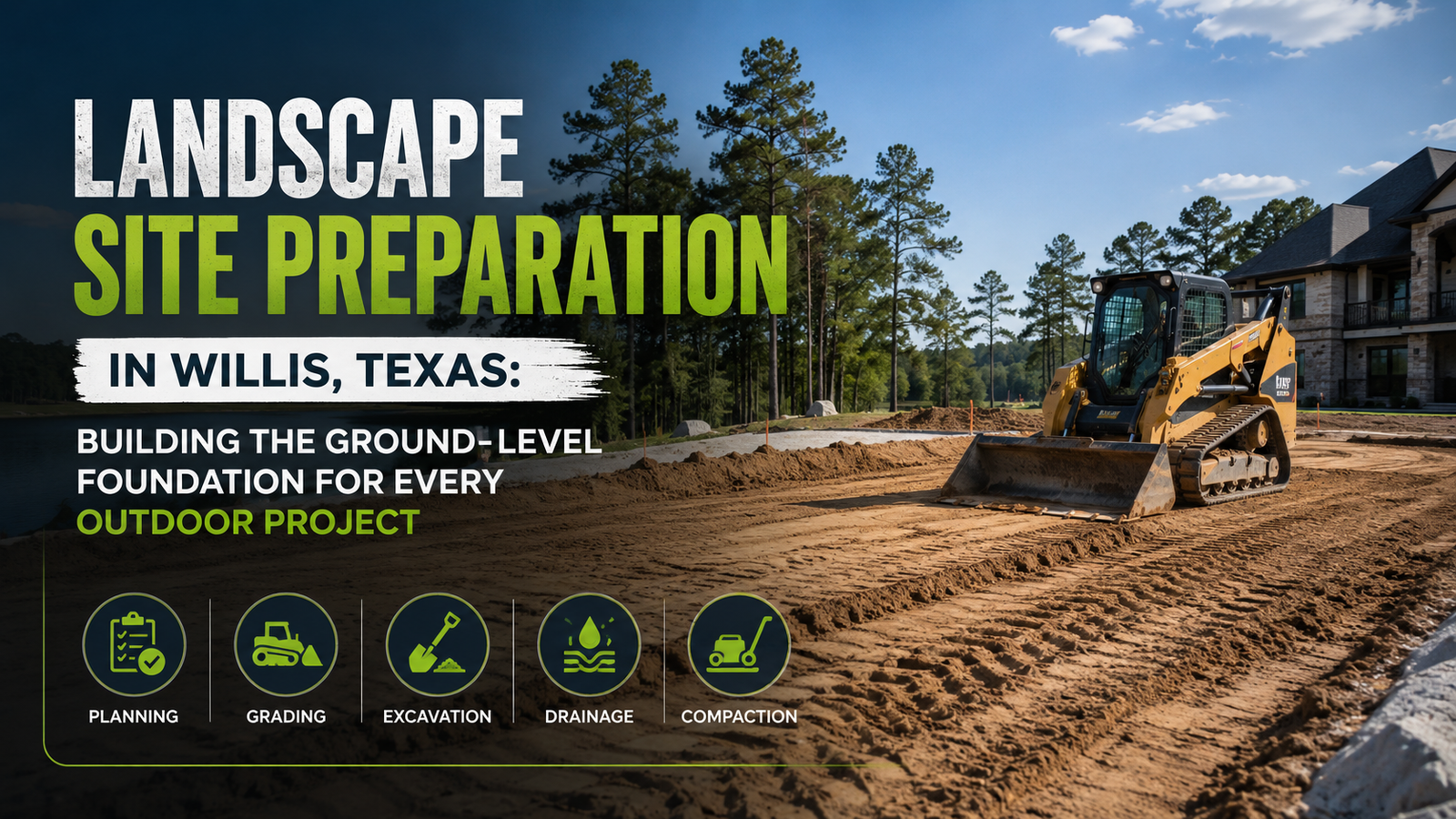
When most people think about landscaping, they picture the finished product the lawn, the garden beds, the trees in their designated spots, the hardscape features that define outdoor living space. What happens before all of that the earthwork, soil management, drainage engineering, and surface preparation that determines whether the finished landscape will perform as intended rarely gets the attention it deserves. Landscape Site Preparation Willis, Texas is the set of services that builds the foundation on which any outdoor project stands, and the quality of that foundation determines whether a landscape investment thrives over years and decades or struggles from the start. In Montgomery County’s East Texas climate, with its challenging soils, intense rainfall, heat, and humidity, getting site preparation right is even more consequential than in more forgiving environments.
What Landscape Site Preparation Encompasses
Landscape site preparation is not a single service but a sequence of operations that transform existing ground conditions into the optimized state required for a specific landscaping outcome. The scope of preparation depends entirely on what is being installed and what the existing site conditions are a site being prepared for a simple turf lawn requires different preparation than one intended to support raised vegetable beds, a drainage swale system, a pond or water feature, a native plant meadow, or the formal gardens of a significant residential estate.
Vegetation removal is the first step for any site that has existing plant cover incompatible with the planned landscape. Overgrown brush, unwanted trees, existing lawn that needs to be replaced, garden beds being redesigned, and invasive species that have colonized a landscape area all need to be removed before new planting or installation can proceed. In the Willis area, this often means dealing with yaupon holly the most aggressively colonizing native shrub in the region which sprouts from roots after cutting and must be managed through both physical removal and follow-up treatment to prevent regrowth.
Grading and drainage correction is often the most technically consequential phase of landscape site preparation. Ground that slopes toward a structure rather than away from it, areas that pond water after rain, low spots that stay wet longer than surrounding areas, and transitions between grade levels that create erosion or water concentration problems all represent drainage challenges that must be corrected at the site preparation stage. Trying to install landscaping over poorly graded ground produces predictable failures turf that dies in wet spots, plants that struggle with inadequate drainage, hardscape elements that erode or shift, and structures that face water infiltration pressure.
Soil amendment and preparation addresses the physical and chemical conditions of the soil that will support plant material. Willis-area soils range from sandy loam in the upland areas to heavier clay in the low-lying zones and near waterways. Neither extreme is ideal for most landscape plants without some preparation. Sandy soils drain too quickly and hold nutrients poorly; clay soils drain too slowly and can become anaerobic (oxygen-depleted) conditions unfavorable for most landscape plants during extended wet periods. Amending soil with organic matter compost, aged wood chips, or other organic material improves both sandy and clay soils, increasing water retention in sandy soils and drainage and aeration in clay soils.
Subgrade preparation for hardscape features patios, walkways, driveways, retaining walls, and other permanent outdoor structures involves excavating to the specified depth, compacting the base material, installing appropriate geotextile fabric where needed, and placing compacted aggregate base course to the required depth and grade. Hardscape that is installed without proper subgrade preparation settles unevenly, heaves, cracks, and fails prematurely often within a few years of installation.
Irrigation infrastructure installation, where planned, typically happens at the site preparation stage before topsoil and mulch are placed, before lawns are established, and before hardscape is completed. Retroactively installing irrigation after the landscape is established requires destructive trenching through finished areas, making pre-planting installation far more efficient and less disruptive.
The Willis, Texas Climate and Its Landscape Site Preparation Implications
Willis and Montgomery County’s climate creates specific site preparation challenges that distinguish East Texas landscape work from projects in other regions. Understanding these climate-driven challenges helps property owners and their landscape professionals make better preparation decisions.
The region’s rainfall pattern approximately 50 inches annually, distributed through wet spring and fall seasons and concentrated in intense storm events makes drainage management the single most important site preparation consideration in Willis. East Texas does not have gentle, steady rainfall that soaks in gradually; it has intense thunderstorm events that deliver significant precipitation in short time windows. Landscape sites that do not have positive drainage water shedding away from structures and toward appropriate outlets will pond after every significant rain event. Ponding that persists is unfavorable for virtually all landscape plants, creates mosquito breeding conditions, and can threaten structures through soil saturation and foundation pressure.
Willis’s summer heat with temperatures consistently in the 90s from June through September and high humidity that slows evaporative cooling creates drought stress during the growing season even in a high-rainfall region. The combination of intense summer heat and heavy-clay soil that bakes hard when dry creates surface conditions that can prevent water infiltration when it does rain, leading to runoff from areas that appear to have adequate rainfall but are functionally drought-stressed. Incorporating organic matter into clay soils during site preparation improves their ability to absorb rainfall efficiently and retain moisture during dry intervals.
The East Texas growing season is long effectively year-round for many landscape plants which means that weed pressure is also year-round. Landscape site preparation that incorporates weed suppression measures pre-emergent treatment of cleared areas, installation of weed barrier fabric under mulched beds, or solarization of prepared soil areas provides a meaningful head start against the aggressive weed and invasive plant pressure that characterizes East Texas landscapes.
Specific Site Preparation Scenarios Common in Willis
New home landscape installation around a recently constructed home in Willis involves a specific set of challenges. During construction, heavy equipment compacts the topsoil that surrounds the building, and the finished grade established by the builder may not create the positive drainage slopes needed for long-term landscape performance. New home landscape site preparation typically involves decompacting the compacted soil around the structure (using aerating equipment, ripping, or tilling), re-establishing a drainage slope of at least 6 inches of drop over 10 feet away from the foundation, and adding organic matter to restore the biological activity and structure of soil damaged during construction.
Acreage property landscape development in Willis presents a different set of preparation challenges. Large properties from 1 to 20 acres or more require longer drainage pathways, larger-scale grading equipment, and careful planning of how storm water will move across the property during major rainfall events. The development of landscape features like ponds, retention basins, or drainage swales on acreage properties requires engineering judgment about where water will flow, how much it will concentrate, and what structures and features need to be protected from inundation.
Landscape renovation replacing or improving an existing landscape rather than starting from bare ground has its own preparation requirements. Established trees may need root zone protection during grade changes. Existing irrigation systems may need to be reconfigured or abandoned before new planting areas are prepared. Invasive plants that have established in the landscape require treatment and eradication before new planting, or they will quickly overwhelm new plantings. The preparation for renovation work is often as complex as for new installation, with the added challenge of working around and protecting existing features that are to be retained.
Erosion Control During Landscape Site Preparation in Willis
The period between clearing the existing vegetation and establishing the new landscape is the period of greatest erosion vulnerability on any site. Bare, disturbed soil particularly the East Texas loam and sandy soils of the Willis area erodes rapidly under the heavy rainfall events that characterize the region. Responsible landscape site preparation incorporates erosion control measures from the earliest stages of vegetation removal through final landscape establishment.
Silt fence permeable fabric supported by stakes, installed along the perimeter of the site and across drainage paths is the standard erosion control measure for residential landscape sites. Silt fence slows runoff, allows water to infiltrate while trapping suspended soil particles, and prevents the sediment from leaving the site and entering adjacent drainage channels and waterways. In Montgomery County, stormwater regulations require erosion control on disturbed sites, and silt fence compliance is a regulatory as well as a practical requirement.
Temporary seeding of disturbed areas with fast-germinating cover crops annual ryegrass in the cool season, millet or sorghum-sudan in the warm season provides vegetative cover that dramatically reduces erosion on soil that will not be immediately covered by permanent landscape materials. These temporary covers can be mowed and incorporated into the soil before permanent landscaping is installed without disrupting the subsequent planting operations.
Common Questions About Landscape Site Preparation in Willis
How important is soil amendment for landscape site preparation in Willis? Very important, particularly for clay-dominant soils in the lower-lying parts of the Willis area. Organic matter incorporation typically at least 3 to 4 inches of compost tilled to 6 to 8 inches of depth significantly improves clay soil drainage, aeration, and fertility, giving landscape plants a far better growing environment than unamended clay provides.
What drainage slope is needed for landscape areas near a home in Willis? The general standard is at least 6 inches of fall over the first 10 feet from the foundation a 5 percent slope to direct surface water away from the structure. In Willis’s heavy rainfall climate, some landscape professionals recommend steeper slopes of 8 to 10 feet of fall over the first 10 feet to ensure positive drainage even during intense storm events.
Should irrigation be installed before or during landscape site preparation? Before ideally at the site preparation stage, before topsoil, mulch, and planting are complete. Installing irrigation retroactively requires trenching through established landscaping, disrupting planted areas and potentially damaging established plants and their root systems. Installing the irrigation infrastructure during site preparation, when the ground is already disturbed and access is unrestricted, is far more efficient and cost-effective.